Taking the Dip Bath: A Holi Bath in Maha Kumbh Mela 2025
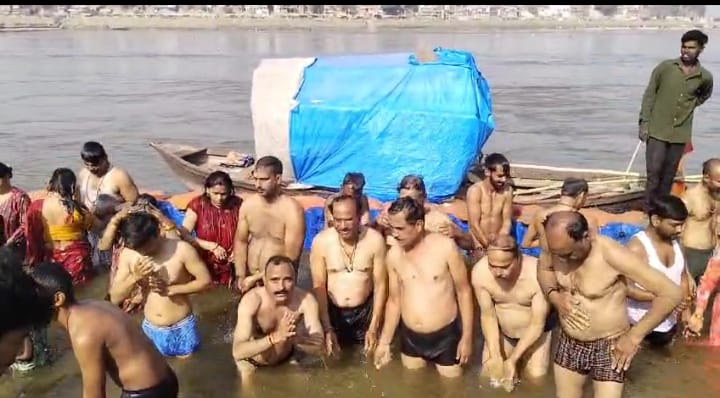
I went to New Delhi last week in February. My friend and philosopher Brijesh Gupta, Ex Chairman and Managing Director, IRCON Ltd, New Delhi, who was retired in December 2024. He was a Divisional Railway Manager, at Central Railway, Nagpur, and was supposed to motivate the Train Ticket Inspectors (TTEs) and Ticket Collectors (TCs) to work honestly. The DRM Office, Nagpur, could not cope with the TTE, TCs in Central Railway. Division was a burden to him since the revenue was very low.
Brijesh Gupta, then The Divisional Railway Manager, Central Railway was looking for someone to motivate his staff, and they got me on the recommendation of Brijesh Dixit, then the Nagpur Metro Man called a ‘pioneer’, who heard my motivation when he was Chief Engineer, Western Railway, Churchgate, Mumbai.
The motivational talk of mine was able to get some change in attitudes and revenues of the Nagpur Division, which was satisfactory to them. I was told by different staff there on various occasions. The Nagpur DRM got transferred and, at last, retired as Member Secretary of the Railway Board. At New Delhi, he had an additional charge as CMD, IRCON to whom I met at Bilaspur, Odisha, Jaipur, and at the Railway Board, New Delhi. My relations continued with him after his tenure as DRM, Nagpur.
As a CMD of IRCON, Brijesh Gupta introduced me to Chief General Manager, Sagrah Mourya, who had been stationed at Banihal (A Project Site of IRCON) and was an IRCON project head at Banihal, J&K. I got an opportunity to have my one Motivation Talk in the office of Director General, Fire Services, J&K, at Head Quarters, Jammu, and then on next day I had been called from Jammu to deliver one of my talk at IRCON PROJECT, Banihal. With my association with the Railways, and then after at IRCON. I started my journey as a young journalist as a GM’s Nominated Member of the Railway Users Consultative Committee when Rajendra Palhan was the then GM, of Central Railway, Mumbai.
I met now working CMD, Hari Mohan Gupta, in his office over a cup of tea and asked him to help me since I was staying in Maharashtra Sadan, New Delhi. The young driver who drove me in a car deeply impressed me with his look and his engineering skills as well.
I asked him, have you been to Prayag Raj, he spontaneously asked and looked at me while he was in the driver’s seat. As he stood before me, no less than Rishi or Muni or even a Pandit, and as a Miracle Man. He provoked me, and my inner feelings, linger upon me as I am old now to here and he was young 25-26, and was a Rajput from Himachal Pradesh. He talked to me with his inner feelings as he thought that I was retired from Railways based on my knowledge about IRCON. We had a 30-minute journey together as he was supposed to drop me next to India Gate, near Baroda House at Maharashtra Sadan. The driver explained to me about purification with Ganga Snan. He further said it is a dip bath and motivated me to be one of the pilgrimages to go Prayag Raj as I was in New Delhi much nearer to there as compared to my hometown Nagpur.
I said, no I am going to Nagpur. Further, he said, “You shall be there sir, unless until you have essential work at Nagpur and it is surely worth, it to take a dip bath. He further said, “Purification by Ganga Snan. I had been there and had a dip bath, sir. it is not dupki, but a Pavitra Snan”. But it is something, that sparked in my mind after he repeatedly said it is “Pavitra Snan”.
As a journalist, I have been to Godavari at Nashik and also went to Ganga at Tikari Road, Patna. I have also traveled to the rivers Bias, Krishna, Kaveri, and Brahmaputra, or might be in temples at the banks of Krishna River in Maharashtra, where the river originates. I wrote articles on those rivers from time to time, but never took the dip bath. The reason is maybe I am an atheist probably!
Making me poised for taking me in the thought of Ganga Snan, made me imagine to go in the city of Prayag Raj, as a pilgrim for Maha Kumbh Mela. The driver finally saluted me as I stood before him, even though he was a Brahmin Pandit from Himachal.
Is this dip bath required in our lives? And as I betrayed the philosophy of Sanatan Dharma?
Thus, finally, I concluded “Get up early in the morning, go to the Ganga for the bath at the time of the rising Sun, and do Surya Namaskar. One should have a strong belief in the heart. Then only one has that inner feeling and happiness, irrespective of your beliefs. Yesterday, you were an animal, but as a human being, our Sanatan Dharma says, “Jio Aur Jine Do”, which means “Live and Let others also Live”.
That way, if you go back to the olden days. Every village you see on the banks of the rivers, and the rivers were the places for human civilisation and development. Because water is the fundamental need for all creatures. Without water, no one can survive on this earth. To have a bath in the morning was a regular practice of humans after the civilisations in Bharat. Doing Pooja to the family god in any house after bath is a regular practice of Hindus. There are many rivers do flow through the land of Bharat and Akhand Bharat has today’s Myanmar (Burma), Bangladesh, Pakistan & Afghanistan.
We have heard of Gandhari of Mahabharat. She was from the “Gandhar Kingdom,” which is now in Afghanistan and is called Kandahar city. A dip bath is needed to come out of the water after one takes a bath and it purifies the soul. Do consider yourselves as not less than a pure soul as the traditions of Hindus still are in existence to preach all these things to our younger generation.
We used to take dip baths, used to pure our hearts first, and then used to see holiness in our inner self. Forget man, animal, trees or leaves, mud, wood, stones whatever as per Hindu Dharma we find almighty in everything.
Finally, it is our Sanatan Dharma teaching all these things which has a lot of scientific reasons, and taking a dip bath at Maha Kumbh Mela.